



Switched-on energy management for busy businesses
We transform business energy from a complex burden into a strategic advantage
Work with our business energy specialists to secure the market’s best rates, protect your margins and move towards net zero with confidence.
Guiding your energy journey
Managing energy at scale is increasingly complicated. Rising costs, volatile markets and shifting regulations can leave even the most experienced teams unsure about next steps.
Tired of ‘one-size’ contracts?
We build bespoke strategies that reflect your unique usage and goals.
Worried about hidden costs?
We spot ways to save and create new value, which other consultancies often overlook.
Struggling with net zero?
We bridge the gap between commercial goals and net zero sustainability.
Smarter energy at every step
Procurement
Meet your perfect procurement match
We dive into your data to match your usage profile with the right fixed or flexible energy contract from trusted suppliers.
Renewable Energy
Understand your route to renewables
We simplify your renewable options, such as Renewable Energy Guarantees of Origin (REGOs), carbon offsetting and 100% renewable electricity, so you can meet environmental goals without overpaying.
Risk Management
Navigate difficult decisions
Knowing when to fix costs and when to wait is something of a science. Our energy consulting team combines pricing insights with real-time, wholesale market data, to build a hedge strategy that guards you against sudden price spikes and allows you to take advantage of market falls.
Contractual Support
Gain stress-free contract support
Suppliers often pass risk onto you. We negotiate complex clauses, like volume variations, change of law and payment terms, to protect your interests.
Out-of-Contract
Remove out-of-contract risks
If you’ve moved premises or a contract has lapsed, you’ll be landed with ‘deemed’ or ‘default’ rates. We act fast to move you onto more competitive terms and negotiate rebates.
Moving Premises
Take the stress out of moving premises
Moving premises is stressful enough without energy complications. We manage the entire process for you - from identifying incumbent suppliers to avoiding expensive backdated billing - so your new site is powered on competitive rates right from the start.
Your energy, managed expertly
Adding value throughout the contract lifecycle
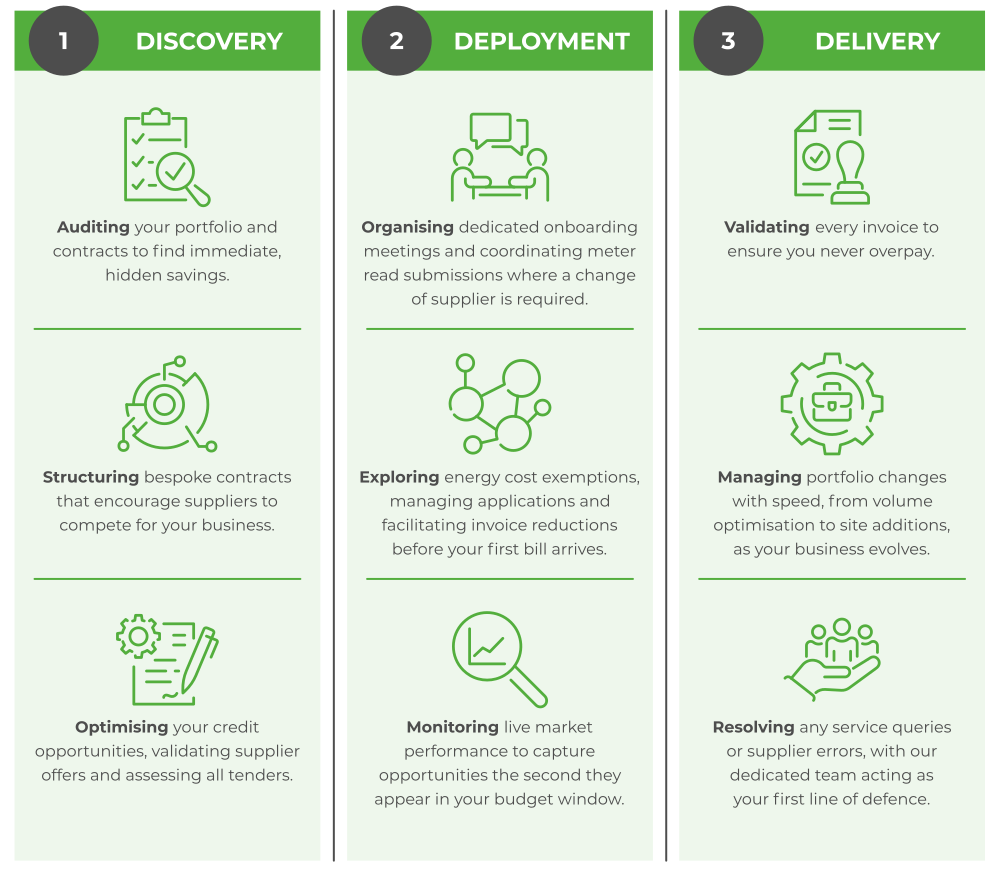
Which energy contract is right for your business?
Fixed energy contracts
Learn moreBest for
Businesses looking for 100% budget certainty.
Key benefit
A simple, ‘set-and-forget’ approach, with a locked-in rate throughout the contract’s duration.
Flexible energy contracts
Learn moreBest for
High-volume energy users, who want to buy gas and electricity when they want, based on their hedging strategy.
Key benefit
More control when you buy, allowing businesses to capitalise on market movements and lower price opportunities.
Verdant Power Portfolio
Learn moreBest for
Smaller businesses that want flexible benefits, but aren’t large enough to typically access them.
Key benefit
Lets smaller businesses access the flexible energy market, all backed by 100% naturally sourced renewable power.
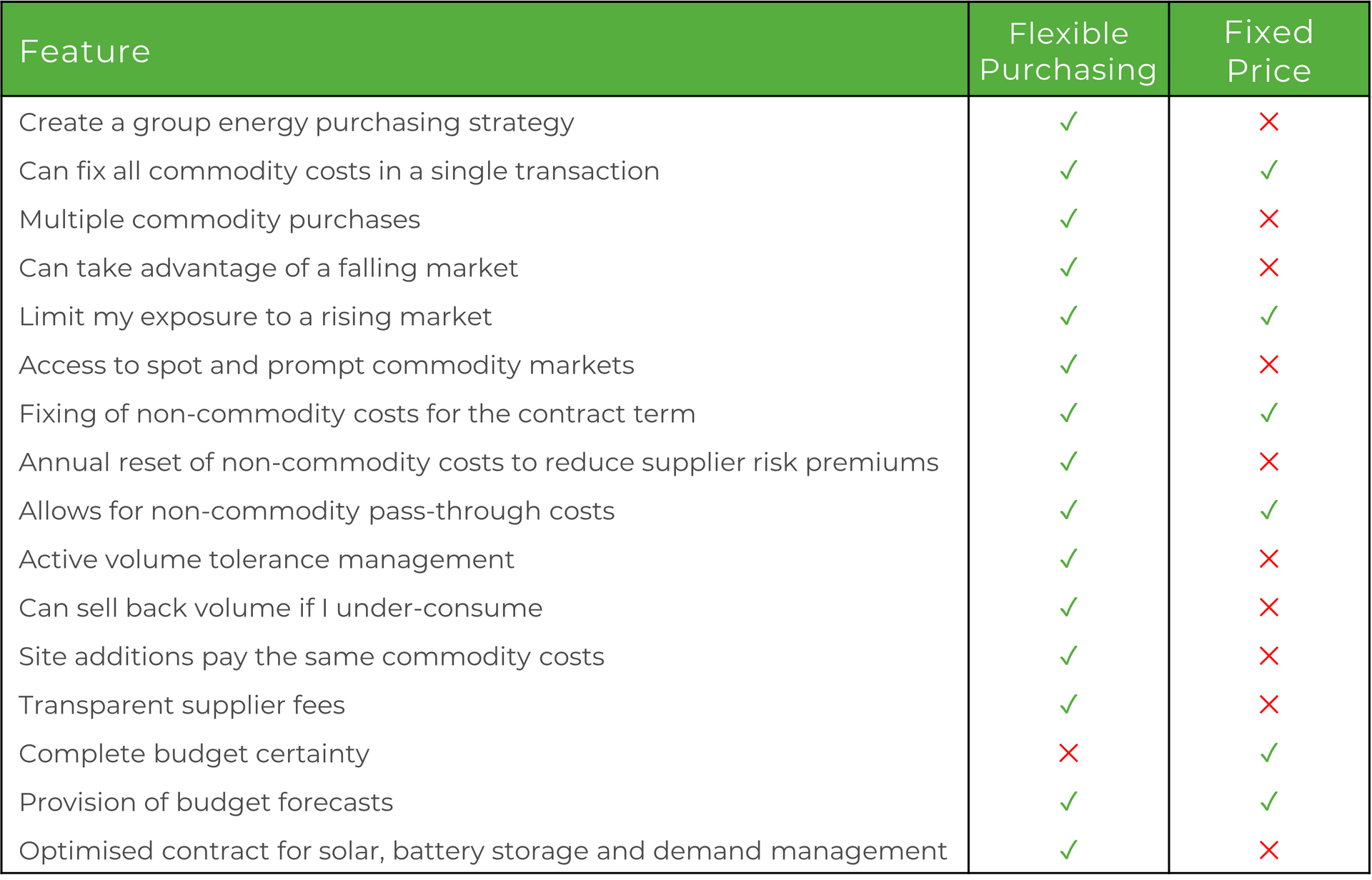
What are the main differences between a fixed price and flexible purchasing energy supply agreement?
A fixed price contract locks in the wholesale commodity price for electricity or gas in a single transaction at the point of contract signature, whereas a flexible purchasing contract is a framework that separates the agreement to supply energy from the timing of when commodity is bought.
Business Energy Product FAQs
What is energy market liquidity?
The term “market liquidity” is often used by energy suppliers to determine how far forward a customer can purchase (hedge) their energy.
It is typically constrained to 4 or 5 seasons ahead but is dependent on how active the wholesale market is. If there are many willing buyers and sellers then the market is called "liquid". In the absence of such activity, the market is "illiquid".
It is possible to purchase energy beyond the liquid period, however, you will pay a "holding" premium as the supplier takes price risk until they can trade your position in the wholesale market or net it internally.
What is Agreed Supply Capacity (ASC)?
ASC is the agreed amount of power allocated to your site, which is important for every half-hourly metered customer.
The cost associated to your allocated ASC is recovered through the 'kVA' or 'Capacity charges' on your bill. If your ASC is set too high, then you will be overpaying each month as you pay for unutilised capacity. If you exceed your ASC then you pay additional penalty capacity charges; otherwise known as “excess capacity charges”, which are set by your Distribution Network Operator.
What are commodity costs?
There are 19 individual cost components to an electricity price, compared to 12 in gas. Some of these costs are referred to as "Commodity Costs". These are the set of costs that refer solely to the commodity elements of your price and may include:
- Wholesale commodity cost
- Liquidity
- Collateral
- Booking/holding risk
- Imbalance risk
- Swing/weather risk
- Shape risk
If you would like to further your understanding of these cost components, please speak with one of our expert consultants.
What are non-commodity costs?
There are 19 individual cost components to an electricity price, compared to 12 in gas. Some of these costs are referred to as "Non-Commodity Costs". These are the set of costs that refer solely to the non-commodity elements of your price and may include:
- BSUoS
- AAHEDC
- RCRC
- DUoS
- TNUoS
- Elexon
- Renewables Obligation (RO)
- Feed in Tariff (FiT)
- Contracts for Difference (CfD)
- Capacity Mechanism (CM)
- Transmission Losses
- Distribution Losses
The number of cost components in the gas cost stack is much reduced compared to electricity.
If you would like to further your understanding of these cost components, please speak with one of our expert consultants.
What are energy transportation charges?
Transportation costs form part of the Non-Commodity Cost stack. For electricity, transportation costs are split across the transmission and distribution systems and are more commonly known as:
- Transmission Network Use of System (TNUoS): This is the cost associated with transporting your electricity from the power station to the Grid Supply Point (GSP); where the voltage is stepped down and enters the local distribution network
- Transmission Losses (TLoss): The cost associated with electricity that is lost on the transmission network (noise and heat)
- Distribution Use of System (DUoS): This is the cost associated with transporting your electricity from the Grid Supply Point (GSP) to your meter
- Distribution Losses (DLoss): The cost associated with electricity that is lost on the distribution network (noise and heat). Losses increase as the voltage is stepped down, which is why losses are higher on the distribution network than on the transmission network
Transportation costs for gas are simpler than electricity as there are no losses on the gas network. Gas transportation costs relate to:
NTS: Levied by the transmission owner and system operator
LDZ: levied by the gas distribution network operators
What are the environmental charges in electricity costs
Environmental charges are part of the "Non-Commodity" cost stack and are more commonly known as EMR charges (Energy Market Reform). These set of costs are designed to provide price signals for suppliers and consumers to support renewable generation, reduce consumption and fund new lower carbon electricity generation. There are four EMR charges that all suppliers are mandated to pass onto consumers:
- Renewables Obligation (RO): Encourages suppliers to support renewable generators through the purchase of Renewable Obligation Certificates (ROCs)
- Feed in Tariff (FiT): Scheme to support small scale generators. The money collected from consumers is used to pay generators
- Contracts for Difference (CfD): Scheme to support investment in new low carbon generation by guaranteeing the commodity price a generator will receive
- Capacity Mechanism( CM): Supports the cost of the CM scheme to provide fixed revenues to generators and Demand Side Response (DSR) successful in annual auctions for availability during periods of peak system demand
If you would like to further your understanding of these cost components, please speak with one of our expert consultants.
Energy consulting that’s truly fit-for-purpose
All this comes with a promise to deliver commercial value at every step, by proactively finding savings, seeking out new opportunities and preparing your business for whatever comes next.
Wherever your energy journey is taking you, we’ll help you get there.